
 Deutsch
 Español
 Français
 Nederlands
 Português
 Русский
 日本語
日本語 Bahasa Indonesia
Quick Summary for Batik Enthusiasts:Although the art form of batik is incredibly intricate, the batik tools used to create it remain beautifully simple. The core of authentic manual batik production relies on four essential elements:
Crafting authentic Indonesian batik is far more than a manufacturing process; it is a generational art form. For those of us who have lived and breathed this textile tradition in Pekalongan since our grandfather first established our workshop in the 1930s, preserving these manual techniques is a daily commitment. Whether we are applying intricate hand-drawn tulis or stamping yard after yard of precise cap designs, our goal remains the same: maintaining a UNESCO-recognized global heritage on every single piece of cotton and rayon we produce.
Behind every masterpiece of world-class batik is a fascinating interplay of simple tools, natural elements, and immense human patience. Let’s explore the fundamental tools and materials that bring these intricate fabrics to life.
The Foundation: Preparing the Fabric (Mori)
The Canvas
The journey of every authentic batik piece begins with the base material, traditionally known as mori. For the intricate designs and vibrant colors to truly take hold, the fabric must be of exceptional quality. Typically crafted from premium cotton or supple rayon, this foundation acts as the perfect canvas. The chosen fabric must possess specific characteristics—most notably, the ability to flawlessly absorb and hold both the hot liquid wax used in the resist process and the rich dyes that follow.
The Preparation
Before a single drop of wax touches the cloth, it must undergo a rigorous preparation process known traditionally as ketel. The fabric is carefully washed and traditionally boiled to strip away any residual starches, oils, or sizing left over from the weaving process. This foundational cleansing step is crucial; it ensures the natural fibers are entirely exposed and receptive. The result is a pristine, unblemished canvas, perfectly primed to embrace the intricate artistry of the wax resist and the deep, lasting penetration of the dyes.
The Primary Instruments of Batik Design
Canting: The Traditional Javanese Wax Pen
Believed to be a purely Javanese invention, the canting (pronounced chan-ting) is the quintessential tool of batik tulis (hand-drawn batik). It is a small, thin-walled copper container connected to a short bamboo handle, typically measuring around 11 cm in length. To create the mesmerizing patterns we see on finished fabrics, the artisan dips the tool into a pot of melted wax, fills the copper bowl, and draws intricate, free-flowing designs directly onto the cloth—much like a calligrapher uses an ink pen.
The Anatomy of the Canting
To truly appreciate the generational craftsmanship behind the cloth, it is essential to understand the anatomy of this deceptively simple tool. For semantic precision, the canting is divided into three distinct parts:
- Nyamplung (The Reservoir): This is the small copper bowl that scoops and holds the molten wax. Copper is intentionally chosen for its excellent heat retention, which helps keep the wax in a fluid, workable state as the artisan draws.
- Cucuk (The Spout): The fine capillary tube where the hot wax flows out onto the fabric. Canting spouts are numbered corresponding to their size to achieve varied design effects. A tiny 1 mm spout is selected for ultra-fine, detailed line work, while wider spouts are utilized to fill in larger design areas. For specialized patterns, dots, or parallel lines, artisans may use multi-spouted tools featuring up to 9 distinct cucuk.
- Gagang (The Handle): The short handle, traditionally crafted from bamboo or lightweight wood. Because the copper nyamplung becomes exceptionally hot, the bamboo acts as a perfect natural heat insulator, allowing the artisan to grip the tool comfortably through hours of meticulous detailing.
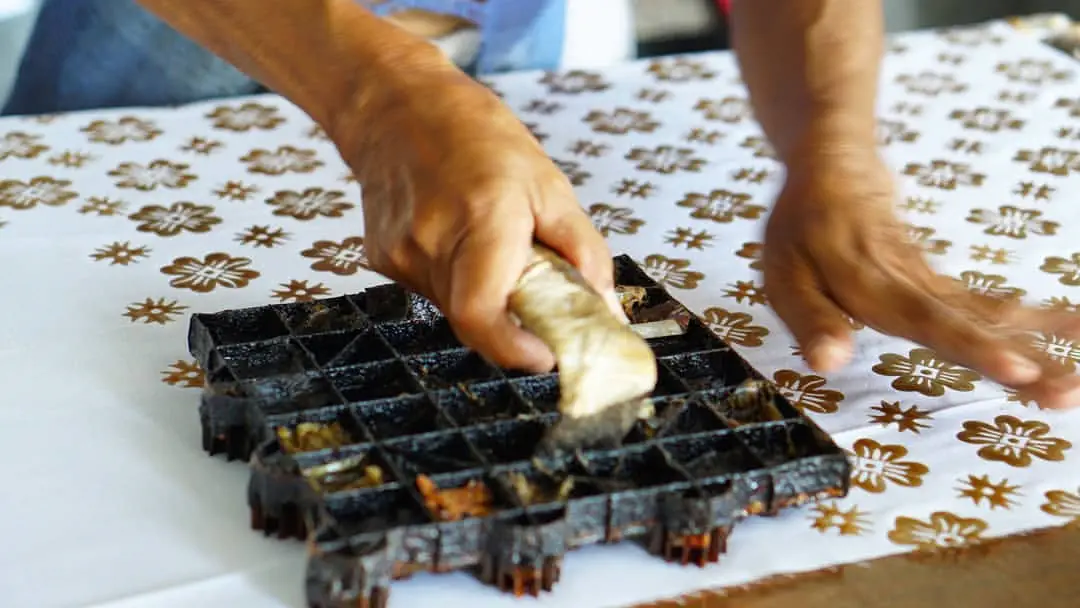
Tjap (Cap): The Precision Copper Stamp
The Historical Context
Creating traditional batik is an inherently time-consuming and labor-intensive craft. In the mid-19th century, as the global demand for these exquisite textiles grew, the tjap (a copper stamp, pronounced “chop”) was developed. This brilliant innovation revolutionized the industry by allowing for a higher volume of batik production. It made the beautifully patterned fabrics more accessible to the masses while strictly maintaining the authentic, manual artisan touch that defines true Indonesian batik.
The Craftsmanship of the Tool
Before a tjap ever touches wax or fabric, it is already a masterpiece of metalwork. Each block is meticulously constructed by skilled toolmakers using 1.5 cm wide copper strips. These strips are carefully bent into intricate design units and welded together to form a repeating pattern. For the finest details, such as tiny dots or delicate textures, smaller pieces of copper wire are seamlessly integrated into the structural base.
The Technique and Precision
Applying hot wax with a tjap requires immense skill, strength, and exactness—a task traditionally handled by male artisans. The stamp must be constructed with absolute precision, ensuring perfect symmetry. This is especially critical because high-quality batik is stamped on both sides of the fabric so that the pattern is consistent and reversible. The copper strips on both halves must align flawlessly. To keep the stamping process manageable and ensure even pressure, a cap block rarely exceeds 24 cm in diameter. A single piece of fabric featuring a complex, multi-layered design might require as many as ten different sets of cap to complete.
Understanding Market Categorization
Today, the quality and classification of authentic batik are defined by how the wax is applied using these primary instruments:
- Batik Tulis: The most exclusive and time-consuming method, featuring designs that are fully hand-drawn using only a canting.
- Batik Cap: Beautiful, repeating geometric or floral patterns applied entirely by hand using the copper tjap.
- Batik Kombinasi (Combination): A harmonious blend of both techniques, often utilizing a tjap for the main background patterns and a canting for fine, hand-drawn embellishments.
Heating Systems and Essential Support
Wajan and Anglo (The Wax Stoves)
The Wajan
While the canting and tjap apply the design, they rely entirely on the wajan to hold their most crucial medium: the melted wax. Resembling a miniature wok, the wajan is a small but robust container traditionally forged from iron, copper, or crafted from heavy earthenware. Its wide, open shape allows the artisan to easily dip their tools while catching any stray drips of hot wax.
The Heat Source (Anglo)
The wax must be kept in a constantly melted, perfectly fluid state while the artisan works. To achieve this, the wajan rests upon a small heat source. Traditionally, this is an anglo—a compact brick charcoal stove or a spirit burner. Maintaining the exact temperature is a delicate balancing act; if the wax boils, it becomes too thin and uncontrollable, but if it cools, it will clog the tools. While modern batik workshops sometimes integrate temperature-controlled electric stoves for greater efficiency, the traditional charcoal anglo is still widely revered for providing an authentic, steady, and radiant heat that seasoned artisans trust.
Gawangan and Dingklik (The Unsung Heroes)
Beyond the direct application of wax, the batik process requires specific support structures that allow the artisan to work with precision over long periods.
Gawangan
When an artisan is drawing intricate batik tulis, the fabric cannot simply be laid flat on a table. It is draped over a gawangan, a sturdy frame constructed from wood or bamboo. This specialized rack stretches and suspends the cloth securely, allowing the fabric to breathe, preventing the hot wax from sticking to underlying surfaces, and giving the artisan the perfect tension and angle to execute their flowing lines.
Dingklik
Perhaps the most humble yet vital tool in the workshop is the dingklik. This small, low wooden stool is where the artisan sits while working at the gawangan. Because a single piece of premium hand-drawn batik can take weeks or even months to complete, the dingklik stands as a quiet testament to the immense patience, physical dedication, and enduring stamina required to master this timeless craft.
The Core Resist Material: Batik Wax (Malam)
The Recipe
At the heart of the batik process is the resist material itself: the wax, known locally as malam. While it might seem like a simple medium, common batik waxes are actually highly complex, carefully calibrated blends. A standard mixture consists of beeswax to provide malleability, and paraffin, which offers the friability needed to create the iconic, crackled vein effects that true batik is known for. To this base, artisans add natural plant resins to increase adhesiveness so the wax grips the fabric tightly, and specialized animal fats to create greater liquidity for a smooth flow. The precise ratios of these ingredients are often closely guarded workshop secrets, passed down through generations to ensure the perfect consistency for specific designs.
Geographic Sourcing
The quality of the final textile is directly tied to the raw materials used in the malam. Rather than relying on generic commercial waxes, authentic Indonesian batik production sources its premium ingredients geographically. The absolute best raw waxes and resins are harvested from specific Indonesian islands renowned for their natural biodiversity, particularly Timor, Sumbawa, and Sumatra. Three main types of petroleum-based paraffin (white, yellow, and black) are also utilized, carefully measured in grams to disguise different parts of the pattern throughout multiple dyeing stages.
Temperature Control
Once the perfect secret recipe is blended in the wajan, mastering the temperature becomes the artisan’s greatest challenge. The wax must be kept in an exact “Goldilocks” zone. A wax that is too cool will thicken and instantly clog the delicate spout of the canting. Conversely, a wax that is too hot will become aggressively fluid, flowing too quickly and penetrating the fabric uncontrollably, which ruins the crisp edges of the intended design.
The Artisan’s Breath
Because the wax is so sensitive to temperature and airflow, a beautiful, intimate rhythm develops between the maker and the tool. Before committing a fine line to the cloth, the artisan will often blow gently into the spout of the canting. This soft, deliberate breath clears any microscopic obstructions and ensures the hot wax is flowing perfectly before it meets the fabric—a poignant reminder of the human spirit breathed into every single piece of handcrafted batik.
Breathing Life into Fabric: Traditional Hand Dyes
The Heritage Palette
Once the intricate wax patterns are meticulously applied, the fabric is ready to be brought to life through color. Long before the introduction of modern synthetic dyes, the soul of Central Javanese batik was defined by a stunning, natural heritage palette. These traditional colorways consist primarily of rich, earthy tones: elegant beiges, deep blues, warm browns, and profound blacks. These colors are not merely decorative; they are deeply rooted in philosophy and nature, extracted directly from the botanical landscape of Indonesia.
Indigo Blue (Tarum)
The oldest and arguably most iconic color utilized in traditional batik making is a deep, resonant blue. This striking hue is derived from the leaves of the Indigofera tinctoria plant, known locally as tarum. The extraction process is an art form in itself. The harvested leaves are mixed with molasses sugar and lime, then left to stand and ferment overnight. Sometimes, sap from the Tinggi tree is added to act as a natural fixing agent.
Dyeing with natural indigo requires immense patience because the dye must oxidize to reveal its true color. A lighter blue can be achieved by leaving the cloth in the dye bath for short periods. However, to achieve the highly prized, deeply saturated dark blue, the cloth must be repeatedly submerged in the dye bath and exposed to the air—sometimes up to 8 to 10 times a day, over the course of several days.
Soga Brown
The second essential color applied in traditional batik is a signature warm brown known as soga. This color, which can range from a delicate light yellow to a rich, dark chocolate brown, is the defining characteristic of classic royal Javanese batik. The dye is carefully extracted by boiling the bark of the Soga tree.
Mengkudu Red
To achieve a deep, earthy red, artisans turn to another traditional botanical source: mengkudu. This dark, almost blood-red dye is painstakingly created by extracting pigments from the roots and leaves of the Morinda citrifolia plant, adding a layer of vibrant warmth to the fabric’s narrative.
The Art of Color Mixing
Through generational expertise, skilled artisans are not limited to just these primary botanical extracts; they can create a seemingly endless variation of traditional colors. By understanding the chemistry of the natural dyes, they master the art of color mixing. A vibrant green is achieved by initially dyeing the fabric yellow, then over-dyeing it with blue indigo. A regal purple is obtained by blending blue and red. When the warm soga brown is layered over deep indigo, it produces a striking, nearly pitch-black hue with rich blue undertones.
Ultimately, the final hue of every authentic batik cloth is a unique fingerprint, determined entirely by the artisan’s judgment on how long the cloth is soaked in the dye bath and exactly how often it is dipped and oxidized.
Frequently Asked Questions (FAQ)
What is the difference between Batik Tulis and Batik Cap?
Batik Tulis is drawn entirely by hand using a canting, making every piece completely unique and highly valuable. Batik Cap is created using handmade copper stamps (tjap) to apply the wax, allowing for faster production and highly consistent geometric patterns while still remaining a strictly manual, traditional art form.
Why does batik wax need to be kept at a specific temperature?
Temperature control is critical for the resist process. If the wax (malam) is too hot, it becomes too thin and bleeds through the fabric fibers uncontrollably, ruining the design’s crisp edges. If it is too cold, it will not penetrate the fabric deeply enough to resist the dyes, and it will instantly clog the spout of the canting.
Are natural dyes still used in modern batik?
Yes. While synthetic dyes are commonly used today for producing vibrant modern colors quickly, premium traditional batiks still utilize natural hand dyes—such as Indigo for blues and Soga for warm browns. These botanical dyes are highly prized for their earthy, authentic tones and their environmental sustainability.
What kind of fabric is best for making authentic batik?
Authentic batik requires high-quality natural fibers, most commonly premium cotton, silk, or high-grade rayon. These natural materials, traditionally referred to as mori, are essential because their porous fibers can effectively absorb the hot wax and allow the liquid dyes to penetrate deeply, ensuring rich, lasting colors.
How long does it take to make traditional Indonesian batik?
The timeline varies drastically depending on the technique and the complexity of the motif. A hand-stamped Batik Cap fabric might take a few days to a week to wax, dye, and boil. In contrast, a highly intricate, fully hand-drawn Batik Tulis piece can take anywhere from several weeks to over six months to complete.
How should you wash and care for authentic batik fabric?
To preserve the intricate details and rich colors—especially on fabrics utilizing natural dyes—authentic batik should be hand-washed gently. It is best to use a specialized natural detergent (such as traditional lerak berry extract) or a very mild baby shampoo. Avoid harsh chemical detergents, never wring the fabric out forcefully, and always hang it to dry in a shaded area away from direct sunlight.
Conclusion
The mesmerizing beauty of authentic Indonesian batik lies in its profound contrast: the fabrics feature some of the most complex, intricate textile patterns in the world, yet they are brought to life using the simplest of manual tools.
From the humble copper canting and precise tjap to the carefully guarded malam recipes and earthy botanical dyes, every yard of genuine batik carries the weight of history. It is a testament to the enduring patience and generational skill of the artisans who create it. By understanding the tools and materials behind the craft, we gain a much deeper appreciation for the artistry woven into every thread.
Explore our authentic, artisan-crafted collections at Batiks Fabric, and bring a piece of this UNESCO-recognized heritage into your own creative projects.
